
Kenmore Records Access at a Glance
Kenmore public records are split by level of government and by the law that governs the file. City Hall holds municipal business such as permits, code files, board records, correspondence, and local licenses. King County keeps most name-bearing land, court, custody, election, and certificate records. State systems add statewide court, corrections, business, and archive searches. An online entry is often only an index, which points to a dated file but does not replace the official document.
| Record group | Keeper | Web access | Access route |
|---|---|---|---|
| City permits, code, boards | City of Kenmore | Permit status and city resources | NextRequest, PDF form, or inspection |
| Deeds, liens, plats, marriages | King County Recorder | Landmark index, 1976 to present | Free search; cart, phone, mail, or counter for copies |
| Parcels and assessment | King County Assessor | Parcel Viewer and eReal Property | Free current reports; agency request fallback |
| District and Superior Court cases | King County court clerks | Washington Courts and KC Script | Index, terminal, portal, counter, or written request |
| Birth, death, marriage, divorce | County health, Recorder, Clerk, or DOH | Limited indexes and archive collections | Application, eligibility proof where required, or archive request |
| Jail and corrections | King County DAJD or Washington DOC | Current custody locators | Free lookup; custodian request for older files |
Separate rules close or limit some material. Court access follows court rules rather than the Public Records Act. Vital certificates, protected voter addresses, adoption and juvenile files, sealed cases, motor-vehicle personal data, and selected sensitive recorded instruments remain subject to their own laws. A custodian must release nonexempt portions when they can be separated from protected content.
Washington Law Opens Kenmore Records
The Washington Public Records Act, chapter 42.56 RCW, applies to identifiable records held by state and local agencies. A requester ordinarily need not live in Washington or explain a personal purpose. The request must seek an existing record, not ask an office to research a person, answer a question, or create a new report. Inspection is free, and an agency that withholds material must identify the legal exemption.
Within five business days, the agency must provide the record or a direct link, acknowledge the request and give a reasonable estimate, seek clarification, or deny it in writing. That deadline covers the first response, not final production. Search time, review, third-party notice, and the size of the set can extend delivery. RCW 42.56.120 allows actual costs or stated defaults for copies and electronic delivery, while staff inspection and redaction time remain free.
Note: The Public Records Act cannot open a record that another state or federal law requires an office to protect.
Landmark Indexes Kenmore Public Records
The King County Landmark search indexes recorded documents from 1976 forward. Most instrument images begin August 1, 1991. Parcel searches reach 1997 forward, and parcel numbers did not become consistent index terms until about 2002. A blank parcel result therefore does not prove that no deed exists. Search a party name as Last, First, try name variants, then narrow by date or document type.
| Landmark field | Input | Practical use |
|---|---|---|
| Name | Last, First | Follows grantor and grantee parties |
| Document Type | Selected category | Narrows deeds, liens, releases, plats, or marriage certificates |
| Parcel ID | First 10 digits | Searches indexed parcel links from 1997 forward |
| Recording Date | Date or range | Reduces a large common-name result set |
| Recording Number | Instrument number | Opens a known recording directly |
| Legal description | Structured terms | Supports plat, survey, and condominium work |
Grantor means the party giving an interest; grantee means the party receiving it. A result may show the recording number, date, title, parties, consideration, parcel data, book and page, legal description, and an image link when allowed. Ordering requires an account. Uncertified copies can print after checkout, while certified copies are mailed. Phone, mail, and the Recorder counter remain available when the portal is not enough.
Older Kenmore Records Leave the Web
Kenmore incorporated on August 31, 1998, so older local material often belongs to King County or regional collections rather than a city department. The recording trail also crosses distinct eras. Landmark supplies the 1976-forward index, but most images start in 1991. The General Recordings grantor and grantee index for 1853 through 1975 is on microfilm at King County Archives.
Archives can provide qualifying uncertified copies of pre-August 1991 recorded documents at no charge. Certified documents and marriage certificates still carry statutory fees. Puget Sound Regional Archives holds 1937 through 1972 assessor real-property cards, some with owners or purchasers, but researchers need a parcel number or legal description. This offline chain matters whenever a web index appears to stop the history too soon.
Kenmore Property Records Need Context
An address search belongs first in King County Parcel Viewer. It accepts an address, parcel number, or condominium name and links to the assessor's full report. The result can show a ten-character parcel number, situs address, taxpayer name and mailing address, appraised value, lot area, levy code, and building counts. Situs means the physical property address. The taxpayer address is where assessment mail goes.
The two addresses may differ. That gap can be useful, but it is not proof of where anyone lives. A trust, company, manager, or mailing agent may appear. The map also warns that parcel lines are approximate and are not a legal survey. Use the legal description and recorded plat when the exact boundary matters.
The official eReal Property service shows the current assessment report. Its entry screen illustrates how county records move from a parcel identifier into land, building, value, tax, and sale details.
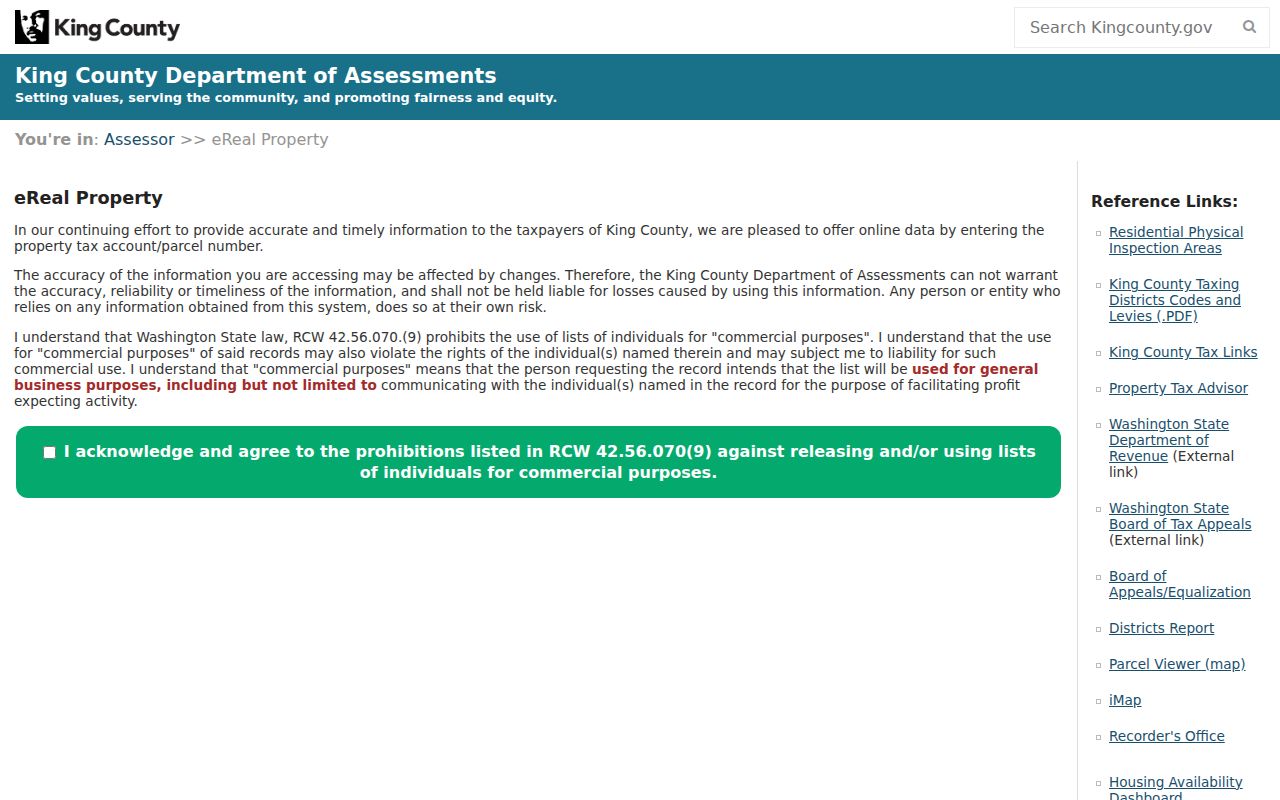
The report can lead to a recorded instrument, yet the deed image and party roles should still be checked in Landmark.
Kenmore Court Indexes and Files
Kenmore has no stand-alone municipal court. The Shoreline division of King County District Court handles Kenmore municipal matters, while civil, felony, probate, divorce, and other Superior Court records go through the Superior Court Clerk. The free Washington Courts Search Case Records offers case, person, attorney, and court-date modes. A person search needs first and last name plus CAPTCHA. Results identify the court, case number, filing date, and case type.
An index is a locator, not a verified disposition or the full file. District Court users can turn to courthouse terminals or a records form, submitted by email, mail, or in person. Electronic prints cost $0.25 per page. Superior Court's KC Script portal requires login, and its listed directly viewable case types generally begin with filings from November 1, 2004. Free Clerk terminals are another route. Ordered portal downloads remain available for 14 days.
Superior Court noncertified copies cost $0.50 per page. Certification is $5 for the first page and $1 for each added page. Sealed, juvenile, adoption, and selected family or protection-order material is restricted under court rules and statutes. Court records use GR 31, GR 31.1, and GR 15, not the PRA.
Kenmore Vital Records Follow Separate Law
Recent vital records are not ordinary open records. Public Health, Seattle and King County issues qualifying birth and death certificates, the Recorder holds marriage certificates, the Superior Court Clerk holds divorce decrees, and the Washington Department of Health provides statewide products. RCW 70.58A.540 excludes vital records from the PRA. Certified birth and death orders require a qualified relationship, identity documents, an application, and the fee.
Marriage and divorce certificates may be ordered without relationship or identity proof. A DOH divorce certificate is a one-page statement of facts; the Clerk's decree is the full court order. Older material follows the archive handoff in RCW 70.58A.510. Live-birth and fetal-death records transfer after 100 years. Death, marriage, divorce, and related listed records transfer after 25 years, after which Archives may provide noncertified public copies unless the record remains sealed.
Certificate limits. Paying a fee does not replace required identity or eligibility proof, and a failed search may still be nonrefundable.
Kenmore Public Records Custodians
The right office matters more than the city name on an event. Kenmore City Hall keeps municipal files, but county offices in Seattle hold recordings, assessments, and Superior Court records. Police disclosure goes to the King County Sheriff's Office, while fire records go to Shoreline Fire. Those contracted service routes prevent a city request from stalling at the wrong desk.
King County Recorder
201 S. Jackson St., Suite 204
Seattle, WA 98104
206-477-6620
King County Superior Court Clerk
Seattle court records counter
Portal or in-person orders
Kenmore Custody Records Have Limits
The King County jail subject lookup searches current adult custody by name and other identifiers. Results may show facility, booking number and time, investigated offense, charge, and bail. They do not establish guilt or a final court outcome. For state custody, Washington DOC searches by DOC number or name and returns current locator data. Former incarcerated people and supervisees may require a direct agency request.
Police reports, 911 audio, CAD records, and statements for Kenmore incidents go to KCSO Public Disclosure, not City Hall. Active investigations and data about victims, witnesses, juveniles, or health may be redacted. Offender notification tools also have limits, and an absent result proves little. Use official results for lawful safety needs only, and never threaten, contact, or harass a listed person.
Kenmore Records Fees and Terms
Free search does not mean free certification. Kenmore charges nothing to inspect records at City Hall. Six or fewer standard pages are free; a request of seven or more costs $0.15 per page for every page. Ten or fewer scanned pages are free, while eleven or more cost $0.10 per page for the full set. Up to 80 electronic files are free, then the charge is $0.05 per four files. Electronic transmission is $0.10 per gigabyte.
The City may require a deposit when copies exceed $75. Recorder and court orders use their own fee schedules. A certified copy bears the custodian's formal certification; an uncertified copy is informational. An index is the searchable description of a record, not always its image. A custodian is the office responsible for the file. An exemption is a law allowing or requiring specific content to be withheld.
- Index
- A locator with names, dates, numbers, or roles.
- Image
- A scan of the filed instrument when online display is allowed.
- Certified copy
- An official copy authenticated by the keeper.
- Exemption
- A legal basis for withholding all or part of a record.
Request Kenmore Public Records Precisely
Start with the custodian's index or status tool, then request the file only when the posted material is incomplete. The City accepts requests through NextRequest or its PDF form. Useful details include the record title or subject, date range, department or person, address, permit or case number, preferred contact method, and delivery or inspection choice. Ask for a defined existing set rather than asking the Public Records Officer to investigate someone.
- Identify the true keeper. Route police to KCSO, fire to Shoreline Fire, deeds to the Recorder, and court files to the proper clerk.
- Search the official online index first. Save exact names, dates, parcel numbers, case numbers, or recording numbers.
- Submit a narrow description through the office portal, form, mail channel, email route, or counter.
- Choose free inspection or electronic delivery when practical, and approve any copy or certification cost.
- Read the initial response. Clarify or narrow the request if needed, and keep the closure notice.
If an agency denies access, the response must state its legal reason. Internal review concludes after the second business day under RCW 42.56.520(4). RCW 42.56.550 permits court review and possible costs, fees, and penalties. Kenmore states that closure begins the one-year judicial-review period.
Lawful use. Open records support family, estate, property, consumer-safety, and civic research. Never use them to stalk, harass, intimidate, or harm anyone.